Friday, 27 September 2013

Bad news, and good

Only known drawing of Soane's proposed house at Burn Hall, a plan showing the room layouts.  Image courtesy of Christie's
Picture: Soane Museum
The National Trust turned down the opportunity to acquire the house of former President of the Royal Academy Sir Albert Richardson with its fascinating collection, which has now been sold at Christie's. The National Trust used to acquire historic buildings, which it held in trust and preserved for posterity. Now it organises tours of the Big Brother house, perhaps to thwart anyone hoping to parody their race to the furthest depths of moronic populism. It's something to do with 'debating the meaning of heritage', apparently

The good news is that Sir John Soane's Museum bought some Soane drawings at the sale. The Soane is a wonderfully eccentric museum in the great architect's own townhouse with some first rate pictures, including two of Canaletto's masterpieces. It also has a magnificent library in the house next door, including much of Soane's work and many other drawings by architects and by old masters. I spent some days there a few years ago going through their Robert Adam drawings - most of his extant drawings are at the Soane. There's no better home for Richardson's Soane drawings. 

I'm just heading up north to see some of Adam's country houses, followed by cycling in the Pennines and then returning home via the Barber Institute in Birmingham, getting back on Monday evening for Artwatch's James Beck Memorial Lecture. It will take my mind of the National Trust's depravity.

Wednesday, 25 September 2013

Another downgraded Rembrandt

Picture: Getty
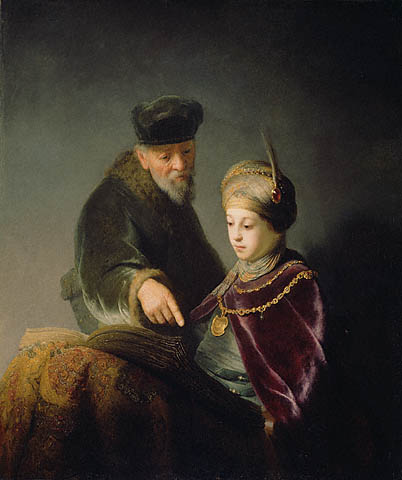
When I looked up this image to illustrate another post I noticed that the Getty now lists this picture as  'School of Rembrandt' . I'm sure it used to be listed as Rembrandt and Dou, which I thought was a bit optimistic. It's interesting how institutions change attributions from time to time without telling anyone (especially if it's a 'downgrade'). Shame there isn't more background on the Getty website, which doesn't give much information about its collection - although they at least make the images freely available. 


Great blogs

Picture: Getty
A reader asks which blogs I read, so here are some recommendations. 

Art History News always picks out the key stories with pithy and insightful commentary (helps that I almost always agree, too!). I love Alberti's Window3 Pipe Problem (a Raphael fan - what's not to like?) and The Frame Blog - all of these are refreshingly upbeat and a great contrast to my brand of miserablism. These blogs are deservedly famous and much-visited; I can't fail to include them on my list, but they scarcely need my endorsement.

The Idle Woman is updated very regularly with substantive reviews of films, books and exhibitions. Well-written, thoughtful and always a good source for interesting things I haven't otherwise come across.

Rembrandt's Room is recently launched, and it's tremendous. Fascinating detailed posts, including a wonderful discussion of Sweerts, an obscure artist particularly liked by the GAH.

David Packwood's blog is updated less often, but it's always interesting and his posts stand the test of time. Well worth dipping into his back catalogue. He's also launched some excellent subsidiary blogs related to his teaching.

Artwatch is simply the most important group in the artworld, calling attention to the depredations of art through bad restoration practices, the risks of damage as art travels around an endless cycle of blockbusters shows, and much else. Posts are thorough, substantive and damning. 

In theory I think it's important to read blogs with a different perspective, but it's too easy to get stuck reading things you like. I recommend Museum 2.0. I disagree with almost every word of it; all of its prejudices are contrary to mine. But it's well-written and thoughtful, so have a look and Know Your Enemy.

Outside art, I rely on The Browser for a daily dose of interesting links on a variety of topics - it's overtaken my previous favourite, Arts & Letters Daily. I must mention Spiked, as they've even published me on occasion! 

The blogosphere in economics and finance is especially rich. Debates are often very polarised, especially in academic economics. A number of top economists are active bloggers, and many of the most important and interesting debates are conducted on blogs. The place to start is Marginal Revolution, because it has lots of well-chosen links and because it is especially open-minded and honest about areas of uncertainty and ambiguity.  

My latest find is The Epicurean Dealmaker, which cannot be praised too highly. It's intelligent, thoughtful and knowledgeable on topics generally debated with stupidity, thoughtlessness and ignorance. His posts always hit the mark. Many of the finance topics that he treats are generally reported by journalists who know nearly nothing about the subjects they cover. This blog, although updated irregularly, could replace 90% of financial journalism. And it's not only right; it's also refreshingly curmudgeonly.  

That's it for the first installment. I'm sure there are others I've missed, so I'll update from time to time on my blog reading.

Sunday, 22 September 2013

Do museums make you tolerant?

Picture: Crystal Bridges Museum/Stephen Ironside
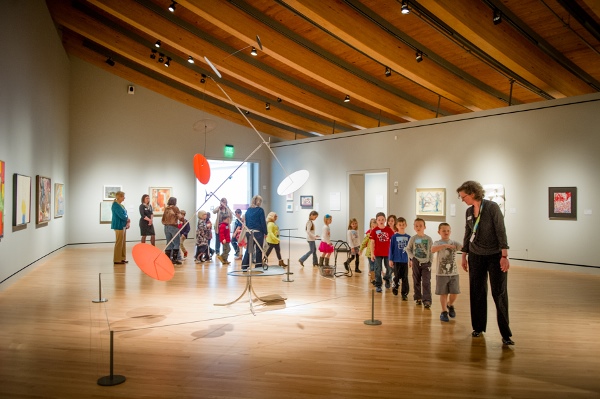
Don Bacigalupi, President of Crystal Bridges Museum of American Art, claims that research proves that after a single visit to his museum with a one-hour tour school students "showed significant increase in critical thinking skills, levels of tolerance and an increase in historical empathy." Sounds impressive, but it's not true.  

The critical thinking score was mainly derived from the students' ability to describe works of art; 96% of the average score for 'critical thinking' came from describing a picture and working out what's going on. The remaining 4% came from things like evaluating, problem finding and flexible thinking - all the stuff we might regard as 'critical thinking'.  It seems odd to me that critical thinking should be one of the key things sought in this study, as it's not generally considered to be one of art's specific virtues. 

Common sense should tell us that such a fundamental aspect of character as tolerance is unlikely to shift measurably after half a day in a museum. I'm still an intolerant curmudgeon despite many days in art museums. The study tried to measure tolerance with four questions, but the methodological appendix concedes that the statistical measure for the internal consistency of these questions - i.e. if they are actually testing the same thing - "falls short of conventional standards". When asked about the statement 'Artists whose work is critical of America should not be allowed to have their work shown in art museums', 32% of students who'd been on the trip agreed versus 35% of those who hadn't. That small difference is meaningful, but the failure to demonstrate that they have a coherent measure for tolerance means you can't claim that school trips to art museums make children more tolerant. The internal consistency score for historical empathy was also weak and only marginally achieved the minimum standard to be regarded as statistically valid. 

Bacigalupi is right to say "no one would dispute the cultural enrichment that [school museum trips] affords these children", which makes me wonder why they're struggling so hard to justify them. We should be especially sceptical of this research because it reinforces generally held views about the value of cultural visits. We're predisposed to give more credence to research that supports our views, and to disbelieve research that challenges our prejudices. But research isn't true just because it's palatable.

The research showed that kids recalled stuff they'd been told a few weeks earlier. And they were able to apply what they'd learned; kids who'd been to Crystal Bridges scored better when writing about a picture they hadn't seen on the trip. Shocking news - children can be educated! I jest, but it's a serious point. The article makes the important observation that school museum trips often eschew teaching in favour of facilitated discussion, on the erroneous assumption that kids won't retain information that's fed to them. I think some of the findings have been over-stated and some important details are hidden away in the statistical appendix, but this is a robust, interesting and useful study. 

Crystal Bridges is over-selling this research, which is irresponsible and unnecessary. But that's not to question the merit of their school tours. From what I can see, it's a serious and well-thought-out programme that sets high standards. It stands tall on its own merits, and has no need of Bacigalupi's extravagant claims. 

Tuesday, 17 September 2013

New acquisitions at the Meadows


One of my favourite museums has just announced a bumper crop of six acquisitions, including a rare colour drawing by Valdes Léal (left) and a panel from a tabernacle by Alonso Cano (right). The Meadows is a museum of Spanish art with some spectacular pictures - outstanding Murillos, Velazquez's wonderful Sibyl and a great Goya alongside fine and unusual pictures by less well known artists. The overall quality is high and I was impressed by the less well-known works, although the condition is rather mixed. The Meadows website is disappointing - there's no comprehensive catalogue of the collection and the illustrations of the new acquisitions are poor. The newly acquired portraits by Miguel Jacinto Meléndez seem to be of more antiquarian than artistic interest. But great to see such an active acquisitions strategy. The Meadows is really one of the best places to appreciate Spanish art. It's a balanced and interesting collection on a small scale in a wonderful building. Worth a trip to Dallas, and you can take in the Kimbell too.

Self-destruction at the Museums Association

Picture: Tate
The Museums Association seems never to have liked museums very much. It always wants them to be something else, something more entertaining and more audience-focused (whatever that means) and more in tune with fashionable nostrums about inclusion and access. Maurice Davies, who is always wrong, summed it up in the title of a recent blog post, 'Stupid Curators'. He thinks the public knows best, except when the public disagrees with him

Some curators took umbrage at their professional association calling them 'stupid' (who'd have thought it?). Their balanced and reasonable comments make an excellent case for the importance of curators. Maurice Davies tried to defend himself with a follow-up post, with a revealing discussion in the comments. He says that he was brought up provocative and provacative he will remain (all to the good, but it rather misses the point that people objected to the substance rather than the style). But when another contributor responded in similarly robust style, Davies accused him of hysteria and libel. 

The defensiveness is telling. The Museums Association's 'Museums Change Lives' agenda reflects ideas that are now less fashionable in government circles. They claim to speak for the people, but the people don't want the things the Museums Association wants for them. And the curatorial profession is rightly standing up for itself against this daft onslaught. 

Sunday, 15 September 2013

'Provenance' and other recent books

Picture: Amazon
Gail Feigenbaum and Inge Reist (eds) Provenance: An alternative history of art Getty 2013

I'm attracted to quirky books, and a history of provenance sounded fascinating. But this is dreadful. Chapters are short and superficial, and the claims made from the evidence of former ownership are not sustainable. Knowing the history of ownership in isolation tells you little; it needs economic, cultural and social context. This volume falls into the trap of reading too much into the raw data of ownership without considering its context. 

Elizabeth A. Pergam's chapter Provenance as Pedigree: The marketing of British portraits in gilded age America starts badly with the claim that the role of dealers is overlooked in the history of gilded age collecting. Overlooked? Art dealer Joseph Duveen might be the most famous character in gilded age collecting, subject of numerous biographies and mentioned in virtually every book about gilded age collectors and collections. Elsewhere she surmises that Duveen Brothers must have been especially anxious to sell a picture because they'd owned it for four years. That fundamentally misunderstands Duveen's business practice, which was often to hold stock for many decades. Indeed when Norton Simon bought the remnants of Duveen in 1964 it included pictures they'd bought more than fifty years earlier. Some of the works sold to Mellon in 1937 came from collections bought three decades earlier. Neglect of context like this means her conclusions are often untenable. For example:
The social formalities embodied in eighteenth-century British portraits, which made them so popular with collectors of the Gilded Age - Huntington, Morgan, and Frick - were less appealing to collectors who had experienced the horrors of Old World politics as manifested in the First World War and the economic crisis of the Depression. Where once identity - and the social hierarchies inherent in family name and association - had been the standard for evaluating a portrait, after the so-called Great War, American art institutions turned instead to aesthetics as the basis for value. (p.117)
Huh? All this is on the evidence of two exhibitions at Duveen Brothers. But simply looking at the collections disproves these daft claims. The portraits bought by Huntington and Frick were of supreme artistic quality (Gainsborough's Blue Boy, Mall in St. James's Park, Hon. Frances Duncomb, Lawrence's Pinkie, Lady Peel - most of which are not of famous aristos). Where is the evidence that 'experience' of World War I changed the outlook of collectors? These absurd claims are unsupported with the evidence supplied, and just ridiculous if considered in a wider context. 

There are some interesting morsels in here, but it's often marred by an attempt to stretch the material too far, to narrate an 'alternative history of art' rather than to elaborate on some fascinating footnotes to the history of art.   
Picture: Amazon

I picked up this book expecting to scoff at the hyperbole of the reviewers, but it deserves the hype. It's a fascinating account of fighting wars today, self-consciously updating the great enlightenment military theorist Carl von Clausewitz. Simpson was a British officer in Afghanistan; like Clausewitz, he's experienced was first hand, and like Clausewitz he brings learning and intellectual sophistication to his task of making sense of war.

Simpson weaves together his own experiences with a discussion of history, theory and politics. Fascinating insights abound. Military thought oscillates between excessive conservatism ('just read Clausewitz') and excessive presentism, thinking that globalisation and technology mean that the past is history. Simpson navigates these excesses with aplomb. He recognises that strategy has always sought to engage audiences rather than simply batter an enemy into submission, but he also recognises that the nature of those audiences and the means of engagement have changed.

I doubt Simpson has studied Hegel, but he's an instinctive Hegelian. This wonderful passage introduces a chapter on strategic narrative, and it's a concrete example of how contingency is retrospectively understood as necessity:
Policy starts as an abstract idea, because by logic it has not been achieved yet; policy finishes as a set of accomplished facts, the policy end-state, which in many cases may not meet the original intent, and may not represent a clear end point, as policy in a conflict merges into post-conflict policy ... [strategic narrative] explains policy in the context of the proposed set of actions in the abstract, and then explains those actions, having been executed, in terms of how they relate back to policy. (p.180)
So much richer than some of the army PowerPoint charts he reproduces later in the chapter!

I've rarely been so excited by a new book. It buzzes with ideas. You'll find this book rewarding even if you don't think military strategy is your thing. The conclusion makes it clear the wider relevance of his analysis given the promiscuous deployment of force by liberal democracies today.
Picture: Amazon

Frantz Schmidt executed 394 people, and flogged, maimed and tortured many more. He was an executioner, chiefly in Nuremberg, and he kept a journal recounting his professional achievements. The physical barbarism is utterly alien to modern sensibilities (execution by beheading was considered the merciful alternative!), but equally striking is the calibrated imposition of violence - should we tear the flesh with red hot pincers twice or four times on the way to execution?

This is really first rate social history, interesting throughout. We know that rank and status were vitally important in early modern Europe, but this book brings it to life with the discussion of the 'untouchable' position of the executioner, forbidden to drink in taverns, attend church or take part in public festivals. We learn about sixteenth century crime, from the petty criminals who won't take 'expulsion' for an answer, and the ghastliness of highwaymen's crimes. 

It's a fascinating tale, but Schmidt's journal was more a record of work than a reflective diary - which is interesting in itself, of course, but rather limits its narrative potential. Harrington honestly describes the limitations of his source, but he seems sometimes to compensate by embellishing the narrative with dubious details. How can we know that Schmidt "followed with amazement, and no doubt disgust, the mass trials and burnings in the Franconian countryside" (p. 206)? The evidence is weak; Harrington notes that Nuremberg resisted the witch-hunting craze, and guesses that Schmidt was 'disgusted' by witch burning. It was disgusting, but why should Schmidt think it so when his contemporaries clearly did not?

The conclusion reaches even further beyond the evidence of the diary, making sweeping claims about the decline of judicial violence in the generations after Schmidt. He claims that the subsequent decline in public executions was because the state felt more secure. It could afford clemency because it no longer had to demonstrate its power with regular public executions. Harrington might be right, but his claims are not supported by his source, and there is little argumentation or discussion of wider literature. It rests on the borrowed authority of Schmidt's story. And Harrington's focus on state security doesn't account for the wider decline of violence in society.

A riveting read but beware its more sweeping conclusions.